
The six autonomy levels are the most quoted table in our industry and the least understood. What are the dynamic tasks a person does at Level 0, what does assisted mean at Level 1, what makes a rule at Level 2 different from a tool at Level 1.
I get those questions in every workshop, and a definition never settles them.
A device moving through the levels does. This summer the power system in my house climbed from Level 0 to Level 3, so here is each level as it looked from inside one house, with what the two levels above it would take.
The climb also turned up the number this issue is about. The vendor's upgrade promised real-time monitoring and printed a 10-minute upload interval on its spec sheet, and the old logger I reflashed instead reports every 15 seconds.
The house draws on the grid, solar, and a battery bank. The inverter is the box that decides which source feeds the house at any moment and how much battery to hold in reserve.
I had already replaced the inverter and batteries in July. The equipment was new, and the operating decisions still came back to me.
Level 0, manual management. The standard says all dynamic tasks are executed manually. A dynamic task is one that exists because something changed.
In my first weeks the grid would drop and I would walk downstairs to read the screen on the inverter, and when the vendor app later put the same readings on my phone the level had not moved, because seeing a number delegates no task.
Level 1, assisted management. The system executes repetitive sub-tasks on pre-configured rules. Assisted means a tool does the repeating part on my command and I keep the judgment.
The first tool in the house was a dashboard button that switches every air conditioner off in one tap when I press it, and records that it did.
Level 2, partial autonomy. Closed loops run on statically configured rules, and only under the conditions the rule was written for. For the first time a person is out of the middle of a task.
When the house is on battery and the load stays above 70 percent of the inverter's rating for 30 seconds, the house switches off one air conditioner, waits 90 seconds, and takes the next one only if the load is still high. The rule runs on fixed numbers and one path, so it is wrong the day the load pattern changes.
Level 3, conditional autonomy. The system senses changes in its environment and adjusts, and the working logic is a policy. A policy governs a group of rules at once, and it says what is prohibited, what is required, and what is preferred.
In the house the prohibited part is fixed, never shed the fridge circuit and never run the battery under 20 percent. The required part is the bedroom staying cool while someone sleeps in it, and the preferred part is the order, guest rooms first, then the living room, with the water pump on solar whenever the sun is up.
The branches switch on conditions, so the target is sunrise on a normal night, the utility's promised return time during a scheduled cut, or the end of the session plus 20 minutes of margin during a booked workshop.
When one number changes, the numbers tied to it change with it, so a later target lowers the load ceiling and lengthens the shedding order. I still decide the policy and its limits.
Level 4, high autonomy. Active and predictive loops across domains, with an intent on top. The intent is the promise in the sense of my last issue, the last thing I write myself, with every number under it derived.
The intent for the house reads in one sentence: the house stays powered until sunrise, the bedroom stays under 26 degrees while someone is in it, and the system reports the moment it cannot keep both. An agent, software that holds the promise and writes its numbers, derives the interior numbers from it, the load ceiling, the shedding order, the hour to pre-cool the rooms on solar before a scheduled cut, and it re-derives them when the forecast, the calendar, or a new air conditioner makes them stale.
One loop now coordinates power, comfort, and the calendar, which used to be separate domains with separate rules. The morning report is a verdict against the promise, held or missed, with the rooms it shed and the margin it kept, and my first experiment at that level gets a separate issue.
Level 5, full autonomy. Every loop in every domain runs across the entire lifecycle, with no person setting goals inside the operation. I have not seen a credible Level 5 implementation, in a house or in a network.
The ladder above is compressed on purpose around one control point, the inverter. On a network TM Forum scores a level per scenario across the whole lifecycle, from planning to retirement, and it asks who senses, who judges, and who acts, each as a separate question.
This story folds those together. It teaches the words and scores nothing, which is the point of A Scenario Has No Interior.
The climb stalled at Level 1, on a number.Getting from Level 1 to Level 2 needed the inverter's data inside Home Assistant, the open-source platform where every brand in the house registers its devices. The old logger had worked with the previous inverter, and with its existing firmware it did not work with the new one. The supported path was the vendor's new WiFi module with cloud reporting, so I asked for faster access to my own data and the answer came back as a hardware order with a shipping date.
With an AI assistant walking me through my first attempt, I wrote new open-source firmware onto the old logger through its programming connection in one evening. The logger now reads the inverter through the inverter's communication port, and the inverter itself was never opened or reflashed.
The logger now reports every 15 seconds, straight into Home Assistant, with no cloud in between.
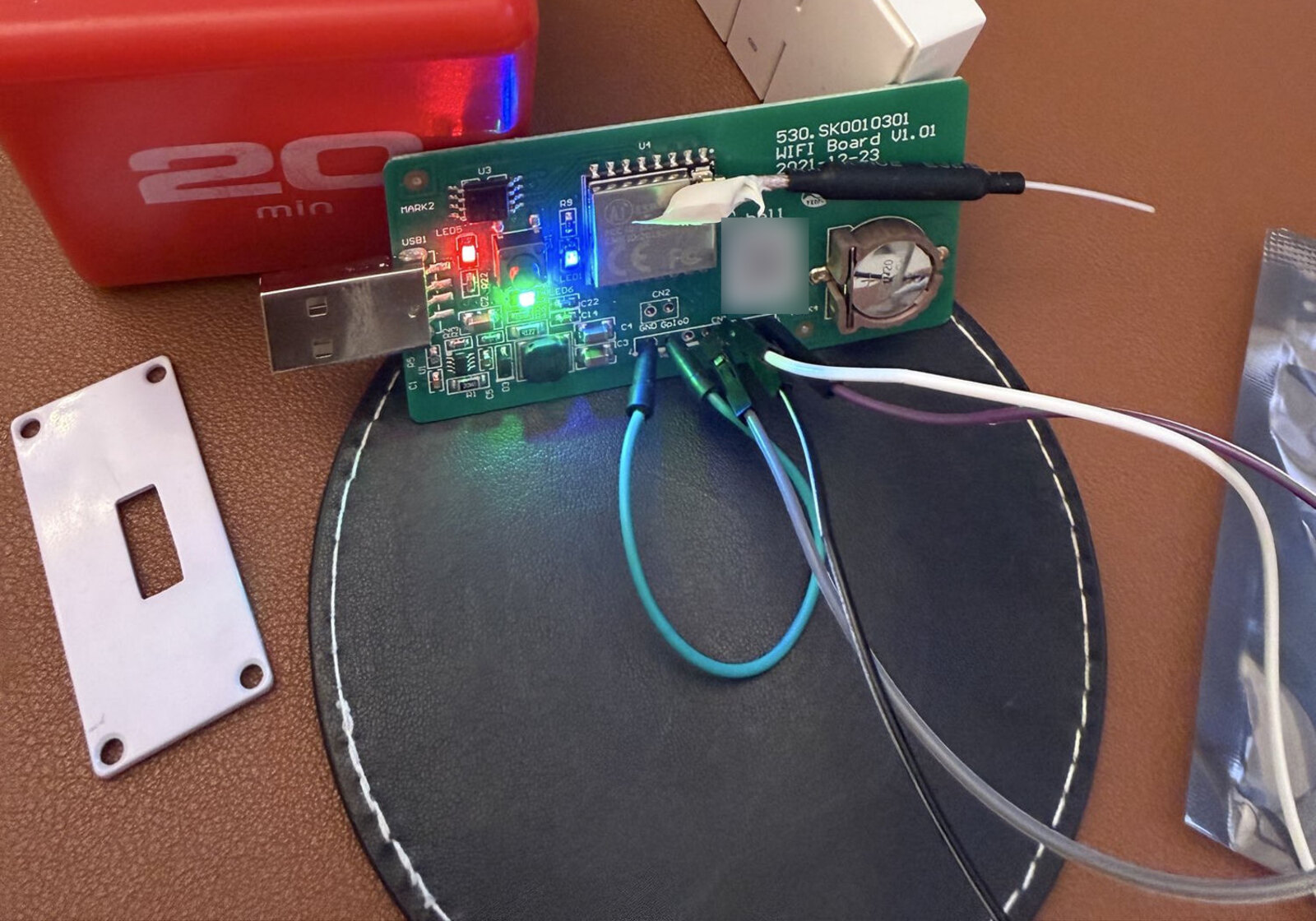
Then I checked what I had been asked to wait for. The vendor calls its monitoring real-time, and the spec sheet for the new module prints the upload interval: 10 minutes.
I would have paid, waited for the box, and bought a 10-minute hole in the data. The old logger proved that the limit was in software the vendor chose to ship.
What 15 seconds buys that 10 minutes cannot.A load that starts and stops inside one 10-minute window can disappear from sampled data or be diluted beyond recognition in an interval average. The battery pays for it, and I find out at breakfast, if at all.
On 15-second data the house sees the load and acts while it is still running. The benefit came first and it was concrete: the battery stopped paying for loads I never saw, and I did not buy the module.
The interval limits what a loop can see in time to act, while who senses, who judges, and who acts determines the level. The shedding rule took the house to Level 2, and the runway policy that picks its target took it to Level 3.
The same assistant turned my spoken instructions into the working rules and the policy, and I supplied the objectives, the limits, and the approval. That made the build faster, and the level still comes from the operating work the deployed system performs.
In The Last Number You Own I argued that automation stalls on who writes its numbers. Every one of those numbers depends on a quieter setting, the interval at which anything is measured at all.
Your network inherits intervals too.Parts of your network also run on inherited reporting intervals. Many performance counters still arrive in 15-minute buckets set long ago as vendor defaults, some in five, and where streaming telemetry exists somebody chose it on purpose.
Fifteen minutes is adequate for some uses. The problem begins when nobody owns the number or tests it against the event a loop needs to see.
Operators run the same three parts at scale. A solar-hybrid tower site has an inverter, a battery bank, and a controller that reports to the NOC on a fixed interval.
The operating loops of that site map to two TM Forum scenarios. Under RAN Fault Management (GB1523A) power supply failure is a separate sub-scenario, and under Wireless Energy Efficiency Optimization (GB1526A) the same site is the sustainability line in the annual report.
A fast battery drain can develop materially between quarter-hour reports. A faster stream gives the loop more opportunities to shed load, switch source, or raise a ticket while the drain is still developing.
The required interval depends on the rate of change and the response time the loop needs, and that is what the person paying for fuel and the person reporting carbon both need to know.
More autonomous without getting more modern.The two paths in my story are the two axes. The new inverter and batteries had already moved the house on the first one, and the new module would have added a current-generation box and a new cloud account with every loop still waiting on me.
Had that module shipped with 15-second data, the house would still have been at Level 1 the day it arrived. The rules and the policy were built afterwards, in the platform, on top of the feed.
The reflashed logger changed no hardware, and an old device now feeds closed loops that act while I sleep.
Modernization, in the part of it this example can show, measures how new the estate is, the technology dimension of digital maturity. Autonomy measures how much of each operating loop is delegated to the system. The business value is still measured through the operational outcome, and the autonomy level records how much of the operating work was delegated to reach it.
An operator can score high on one and low on the other, in either direction. An assessment that collapses the two will misread both.
Modernization is priced by the vendor, while autonomy on the existing estate is priced by the loops you build, so an operator with two million subscribers builds the same decision logic as the largest group, at a smaller integration and assurance scale.

The reflash worked because the inverter has a standard communication port. I could change one side of the plug and leave the other side sealed.
In a live network a change like this goes through the approved, validated, and supportable route, and the lesson is the seam. TM Forum's Open Digital Architecture (ODA) gives that same vendor boundary an architectural form, a component with open interfaces that a procurement office can name in a contract.
The operations and business support systems, the software that runs the network and the customer side, become components from different vendors connected over open APIs. The interval requirement can then be settled on the components a loop touches, without renegotiating the whole estate.
That is how a brownfield estate gets more autonomous without a modernization program. The components give every loop a place to attach, and building the loops is still the operator's work.
Put a number behind real-time.When the next vendor response promises real-time visibility, ask for the interval in seconds and compare it with the duration of the incidents the loop needs to catch. The number passes if it would have caught the last of them while it was still running.
A vendor that ships a local interface fast enough for the target loop, through an open port, passes the same test. The old logger proved the interface already exists in the hardware, so a vendor that ships it is selling something real.
If the number matches what you already have, the upgrade buys you a new box and the same hole in the data.
The interval affects more than which incidents a loop catches. Many Level 4 implementations depend on predictive models, and those models inherit the resolution of their training data.
How often data arrives determines how soon the loop can respond, and what the report preserves determines what can be learned from it later. When a report retains only a 15-minute average, a short event can remain as a diluted contribution while its timing and shape are lost, and an alarm log holds only the moments a threshold was crossed, without the build-up before each one.
For events on that timescale, 15-second samples keep the short loads and their build-up in the record. For counters used as model inputs, what the source keeps and how often it reports decide together which events survive in the training data.
3GPP already has both mechanisms. TS 32.401 delivers performance counters as files and lists 5 minutes as its shortest period, while TS 28.532 supports streamed performance data with the period set in seconds. The design choice belongs to the loop: counters needed for time-sensitive action go on the stream at the interval required to catch the event, while counters that do not need that resolution can stay file-based, often at 15 minutes.
Modernization changes the estate, and autonomy changes who operates it. A new box moves the first score on delivery day, and the second moves only when someone builds a loop on top of it.